

Welcome
to the historic palace park in Sławików
a place that stands as a silent witness to the history of the village, its inhabitants, and its former owners. The park is part of the former palace and park complex.
In 1831, the Sławików estate was acquired by Baron Ernst von Eickstedt. The von Eickstedt family was connected with Sławików for generations and is remembered by the local community as a respected family. Generations of local families worked on the estate, and surviving accounts speak of the owners’ kindness and concern for their employees. One known example is the story of how the Eickstedts, on the occasion of their wheelwright’s child’s First Holy Communion, ensured the child had festive attire by dressing them “from head to toe”. The von Eickstedt family remained the owners of the estate until 1945.
There is a cemetery chapel the von family Eickstedt mauzoleum located within the park.
As you stroll through the park, remember that you are walking along the paths of history.
PARK RULES
- RESPECT HISTORY Respect the park’s historic character and its preserved historical features.
- RESPECT THE MEMORIAL SITE Maintain silence, solemnity, and respect near the cemetery chapel.
- PROTECT NATURE Do not damage trees, shrubs, flowers, or other park features.
- KEEP IT CLEAN Do not drop litter. Please dispose of waste in the designated bins.
- NO SMOKING Do not smoke cigarettes, tobacco products, or e-cigarettes.
- NO ALCOHOL Do not consume alcoholic beverages.
- NO OPEN FLAMES Do not light campfires or use barbecues or open flames.
- LOOK AFTER YOUR DOG Keep your dog on a lead and clean up after it immediately.
- SAFETY Do not enter with motorised vehicles. Follow all signs and regulations.
- RESPECT THE PEACE Do not organise parties, events, or photo shoots, or set up stalls or other structures, without the site manager’s permission.
Sławików palace – the heart of the residence
FROM A MONUMENTAL RESIDENCE TO A RUIN
The history of the manor house in Sławików dates back to the 18th century. During this period, its owner was Jan Gottlob von Drechsler. Later, the estate passed into the hands of the brothers Friedrich and Karl von Ingersleben. In 1795, the property was acquired by Adolf von Eichendorff—father of the famous poet Joseph—for 106,000 thalers. In 1831, for the sum of 62,000 thalers, Ernst von Eickstedt became the lord of Sławików. Between 1856 and 1865, the palace was rebuilt in an eclectic style with Neo-Renaissance and Classical elements, giving it an impressive, grand appearance. The magnificent building was distinguished by its exceptional scale—it was designed to accommodate 100 chambers.
THE MYSTERY OF THE 99 CHAMBERS AND TAX LAW
A clever strategy of the former owners was associated with the palace: it was officially stated that the residence possessed only 99 chambers, with one of them intentionally left unfinished. This was by no means due to a lack of funds, but rather resulted from the law of the time—buildings with 100 or more rooms were subject to significantly higher taxes, as well as the obligation to receive and billet soldiers. By declaring 99 finished rooms, the von Eickstedt family effectively protected their privacy and fortune.
THE GOLDEN YEARS OF THE RESIDENCE
The Sławików estate was not only the administrative centre for the surrounding properties, but also a vibrant hub of culture and social life. Visited by distinguished guests from all over Silesia, it was famous for its exquisite banquets, art collections, and hunting traditions passed down through generations.
THE WARTIME DECLINE AND THE PRESENT DAY
During the fighting over the Oder crossing in the spring of 1945, the palace suffered only minor damage. The true end of the residence’s glory came after the war—as a result of deliberate looting and mindless devastation, condoned by the then-communist “people’s authorities”, the building gradually fell into ruin. Today, the structure remains secured, and its majestic walls still stand as a reminder of the former power and architectural craftsmanship of its creators.
Local legends and tales
Sławików Tales with a Shiver of Dread and a Touch of Historical Mystery
I. THE MEDIEVAL FISHERMEN AND THE ORIGINAL CHAPEL
The legend from the 10th century, tells about three fishermen who lived, on the eastern edge of today’s village. They erected a small, wooden chapel in honour of Saint George as a votive offering for their miraculous survival during a violent flooding of the Odra River, which currently flows right past the historic palace hill. The statue of a bishop (identified as Saint Adalbert), placed atop the side altar in the Sławików church, holds a crosier in his left hand, whilst wielding an oar in his right. For generations, the residents of Sławików have believed that this oar was a gift from those three fishermen.
II. THE TARTAR INVASION: THE BELL AND THE HIDDEN SWORD
In 1241, Tatar invaders captured Przemko—the sexton of Sławików—who had hidden his wife Dobrochnna and their 8-year-old son Sławek in the church tower, whilst he himself began to sound the alarm to warn the village. Dobrochnna perished from Tartar arrows. The orphaned boy wandered the forests for years as a pauper. When he returned years later to the rebuilt Sławików, the church bell, which no one had previously been able to set in motion, began to toll on its own accord. Sławek died of exhaustion beneath the church tower. At the moment his body was laid to rest during the funeral, the bell let out a final, mournful sound and cracked into three pieces from immense grief. *
Another legend states that in 1241, Ruthenian knights fleeing from the Tatars hid a relic in the vicinity of Sławików—the sword of Saint George—which to this day lies somewhere near the former church, awaiting its discoverer.
* The wooden church of Sławików was consecrated in 1223 by the Bishop of Wrocław, Wawrzyniec. In 1849, the little church, along with its bell tower (lacking a bell), was moved to Zabełków.
III. THE WHITE CASTLE
In ancient times, among the forests and fields of Sławików, there was the White Castle. It was inhabited by a mighty royal marshal and his wife—a foreign lady with hair as bright as flaxen yarn. Despite living in immense wealth, the marshal’s wife’s heart was consumed by an unexplained longing and deep sorrow. Loving his wife more than life itself, the marshal wished to restore the smile to her face. He brought her crystalline water from the purest springs and ordered nightingales to be brought so that their singing might soothe her sleep at night. In his devotion, the knight went to the lengths of madness—he attempted to capture sunbeams for his beloved, a venture which cost him his sight completely. Although no trace remains of the White Castle, and the site was later overgrown with rapeseed fields, this legend has bestowed a fairy-tale and mystical character upon the origins of Sławików.
IV. JOSEPH VON EICHENDORFF AND THE ‘GREY LADY’
Before the Sławików estate passed into the hands of the von Eickstedt family, it belonged to the von Eichendorff family. An extraordinary tale concerning the famous poet Joseph von Eichendorff is associated with this place. According to the legend handed down, during a stormy night, together with a count and a servant, he decided to wait for the appearance of the apparition of a woman in a grey dress and cloak, who allegedly visited the palace, exiting through an iron door that no one was able to open. The figure indeed appeared, and the servant, unaware of the situation, ran up with a light to illuminate her path. The lady pointed him in a direction and vanished behind the door along with the servant. A moment later the servant’s terrified scream was heard, behind the door and the flame of the poet’s candle went out. Upon returning with a new candle, they found the lifeless body of the servant and the iron door shut tight once more.
V. PALACE MONSTERS
The local folk avoided walking around the residence for fear of “monsters”—people with deformed limbs and infirmities resulting from diseases, who allegedly inhabited some of the palace rooms, and to whom all misfortunes and tragedies in the village were attributed.
The stories above constitute local legends, folk tales, and motifs rooted in the ancient oral tradition of the Racibórz region.
The cemetery chapel – the von Eickstedt family mausoleum
A PLACE OF REST AND REMEMBRANCE
The 19th-century Neo-Gothic chapel, built as a family mausoleum, complements the local cemetery. Laid to rest in its crypt were the bodies of the deceased members of the von Eickstedt family, including Baron Ernst von Eickstedt, who passed away in 1865. It was during his lifetime that the new Church of St George was erected in Sławików. The chapel served as a sacred and sepulchral commemoration of the influential dynasty that managed the Sławików estate.
ARCHITECTURE AND SYMBOLS
The building was constructed of red ceramic brick, representing the English Neo-Gothic style. Its facade and walls are adorned with characteristic pointed-arch windows, stone mouldings, and rich stonemasonry details. Among the surviving architectural features, one of the original pinnacles (fials)—slender decorative turrets designed to support the structure—is particularly noteworthy; crowning one of the gables, it stands as a testament to the chapel’s former elegance. The entrance to the burial crypt is located at the back of the building, whilst traces of past ornamentation and coats of arms remain visible on the facade to this day.
A TRAGIC FATE AND PRESERVATION
After 1945, the chapel shared the fate of the palace complex, falling victim to devastation and looting, and gradually declining into ruin. Currently, measures are being taken to secure and preserve the site as a place of remembrance and a vital part of the region’s cultural heritage.
Please maintain silence and show respect for this site.
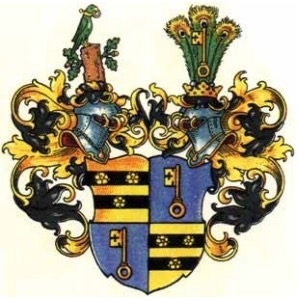
Coat of arms of the von Eickstedt family
Sławików’s green heritage
The trees, garden and orangery of the former residence
I. THE KING OF THE PARK – THE LONDON PLANE TREE
This tree is a living monument of Sławików’s history, planted during the golden age of the residence.
- Uniqueness: It impresses with its majestic size and characteristic, peeling bark, which creates unique, “marble-like” patterns.
- A sanctuary for life: The ancient tree has natural hollows and cavities, which has become home to a colony of bats that find safe shelter here.
- The power of nature: Spending time in the vicinity of such ancient trees is a form of “forest bathing” (shinrin-yoku). They are credited with calming properties, reducing stress and boosting vital energy.
- Curiosity: Plane trees are “masters of survival”—they cope perfectly with difficult conditions, which is why they frequently adorned residential parks.
II. AN OASIS OF BIODIVERSITY
The park in Sławików is rich in species that create a unique microclimate.
- Mighty neighbours: Here, you will find majestic pedunculate oaks, common beeches, horse-chestnuts, common hornbeams, Norway and sycamore maples, birches, Japanese magnolias, European ashes, European black pine, wild cherries, small-leaved and large-leaved limes, and European white elms.
- Spring awakening: In spring, the park blooms with a carpet of wild garlic, which scent and white flowers create an unforgettable spectacle of nature.
- Utilitarian character: The former park was also a place of work and life. The fragments of walls you pass are the remnants of the old boundary wall separating the residence from the agricultural fields.
- The rose garden and Dutch roses: In the southern part of the former palace complex, there was a multi-tiered rose garden situated behind a massive brick pergola, while beautiful Dutch roses grew right at the entrance to the palace, which were stolen after the war along with the rest of the decor.
III. THE ORANGERY – THE WINTER HEART OF THE GARDEN
A particularly striking impression was made by the winter garden, where the family motto was carved beneath the family coat of arms, guiding successive generations of owners: “Stat robur in fide”—Strength lies in faith. The orangery was not merely a building; it was a “parlour under glass”.
- Purpose: It served to overwinter exotic plants that would not survive Polish winters, standing as a testament to the high horticultural culture of the owners of Sławików.
- A walk through time: The old alleys led between the trees, and carefully planned vistas allowed the palace to be admired in its full glory. Today, marked by the passage of time, the orangery still stirs the imagination, allowing us to reconstruct its former splendour.